
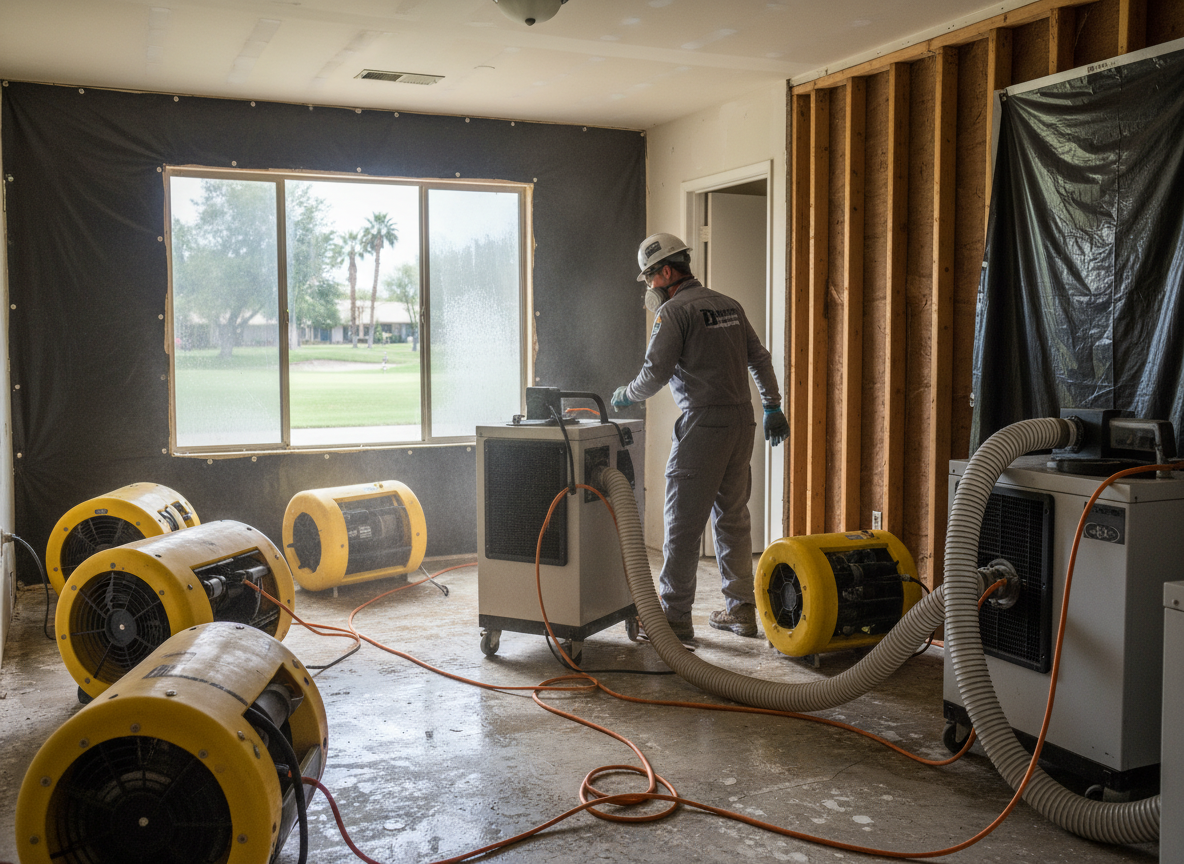
Sun City homes built in the 1960s and 1970s often feature single-story concrete block construction with limited attic ventilation. After monsoon storms, water enters through roof penetrations or window seals and travels along stucco ledges into wall cavities. Industrial dehumidifiers must run at 30-40% relative humidity for several days to pull moisture from the block without cracking the stucco finish. Air movers placed at floor level prevent condensation on cool tile surfaces common in Lakeview properties.
Hot desert days followed by mild winter nights create large daily temperature swings that trap hidden moisture behind drywall and under cabinets. Technicians use moisture meters on both sides of interior walls and behind baseboards to locate pockets that standard fans miss. In Sun City Core neighborhoods, older HVAC ductwork routed through attics can recirculate humid air if drying equipment is not isolated from the system. Proper containment with plastic sheeting keeps dust and spores from migrating into adjacent rooms during the process.
Maricopa County building practices in the 1970s left many homes with minimal vapor barriers under slab floors. When storm water pools against the foundation near Sun City Golf Courses, capillary action pulls moisture upward into subfloor plywood. Dehumidification units must be paired with floor mats and directed heat to dry these layers without warping engineered flooring installed in later renovations. Skipping this step often leads to cupping floors months after the initial event.
Nearby Surprise and Peoria properties share similar irrigation canal proximity that raises local water tables after heavy rain. Technicians monitor indoor humidity every four hours because rapid drying in desert air can leave residual moisture in insulation that later supports mold growth. Final verification includes thermal imaging and pin readings below 12% moisture content before equipment removal.
Technician insight
In Sun City the thing that catches most people out with Structural Drying & Dehumidification is the temperature swing between hot days and cool nights. Moisture condenses inside concrete block walls overnight if dehumidifiers are not kept running at the right settings, especially in the older Lakeview homes built before modern vapor barriers.
Lakeview Monsoon Intrusion
Water entered through a roof valley during a July storm and traveled into exterior walls of a 1972 concrete block home. Initial readings showed 28% moisture in the drywall and insulation. Technicians placed dehumidifiers and floor-level air movers while isolating the HVAC. After five days of monitoring, readings dropped below 12% and no mold growth occurred.
Structural Drying & Dehumidification Services We Offer
✓Moisture Mapping and Assessment
Pin and non-invasive meter readings across walls, floors, and ceilings to locate hidden saturation before equipment placement.
✓Industrial Dehumidifier Deployment
High-capacity units sized for concrete block construction that maintain 30-40% relative humidity without damaging stucco finishes.
✓Directed Air Circulation Setup
Strategic air mover placement at floor level and in wall cavities to move moist air out of single-story Sun City homes.
✓Slab and Subfloor Drying
Floor mats and low-profile dehumidifiers used on concrete slabs common in Lakeview and Sun City Core neighborhoods.
✓HVAC Isolation During Drying
Temporary sealing of ductwork to prevent humid air recirculation through older attic-routed systems after storm events.
✓Post-Drying Verification
Thermal imaging and final moisture meter checks to confirm levels below 12% before equipment removal.
Structural Drying & Dehumidification Cost in Sun City, AZ
| Service | Typical Range | What Affects It |
|---|---|---|
| Single room drying package | $450–$850 | Includes 3-5 days of equipment; higher for block wall saturation |
| Whole-home structural drying | $1,200–$2,400 | Multiple dehumidifiers needed after widespread storm intrusion |
| Slab and subfloor drying add-on | $300–$600 | Floor mats and extended runtime for concrete slab homes |
| Daily equipment monitoring visit | $75–$125 | Per visit after initial setup; required for insurance documentation |
Ranges are typical for Sun City, AZ and confirmed with an exact written quote before any work starts.
How it works
- 1
On-Site Moisture Assessment
Technicians arrive with meters and thermal cameras to map saturation in block walls and under cabinets typical of Sun City homes.
- 2
Equipment Placement And Containment
Dehumidifiers and air movers are positioned while plastic barriers isolate affected rooms from the rest of the house.
- 3
Daily Monitoring And Adjustment
Humidity and moisture readings are checked every four hours and equipment is repositioned as drying progresses.
- 4
Final Verification And Removal
Thermal scans and pin readings confirm safe moisture levels before all equipment is removed and the home is returned to normal use.
Pricing
Pricing depends on square footage affected, depth of saturation in block or slab, and duration of equipment runtime.